Wednesday, 19 November 2025

MSc Historic Conservation: field trip to ex-RAF Bicester


Oxford Brookes Historic Conservation MSc students visit ex-RAF Bicester, England’s best-preserved WWII-era airfield. Originally established in 1916, the site was laid out in its present form from 1925 onwards as part of Sir Hugh Trenchard’s Home Defence Expansion Scheme. The Domestic Site, a campus-like cluster of accommodation, training and workshop blocks arranged in trident formation amid lawns and trees, gives access to the Technical Site with its vast hangars - built to accommodate heavy bombers of up to 100ft wingspan - and the Flying Field beyond. The site is now a Conservation Area containing numerous Listed Buildings and Scheduled Monuments; for the last decade it has been home to automotive and aviation business centre Bicester Motion, which has sensitively converted the existing buildings while exploring options for further development.

Our guide for the afternoon was Oxford-based heritage consultant Nicholas Worlledge of Worlledge Associates, who has provided specialist conservation and planning advice throughout the process.


Thanks to David Garrard for the report. And for more information on the MSc Historic Conservation at Oxford Brookes click here. 

Tuesday, 11 November 2025

Letters from the Street: Bringing Fine Art Methods into Urban Design Teaching

Letters from the Street: Bringing Fine Art Methods into Urban Design Teaching

By Dr Laura Novo de Azevedo, Associate Professor, Oxford Brookes University

As many of you know, I am someone who learns by doing, thinking, making, questioning, and being in dialogue. Learning is not something I ask only of my students, it is something I ask of myself. This year, I decided to take up a new challenge and began the MA in Fine Art at Brookes, and I am absolutely loving it.

As an educator with a long-standing interest in creativity, collaboration, and public life, it feels entirely natural to bridge the worlds of urban design and contemporary art. I hold academic responsibilities in the Faculty of Health, Life and Technology, yet I now also walk, sketch and think alongside artists in the Faculty of Arts, Humanities and Social Sciences.

This crossing of boundaries is purposeful. I am part of a group leading a transdisciplinary teaching and learning project, alongside colleagues Emma Skippings, Esra Kurul and Lucy Turner, exploring how learning transforms when we bring two or more modes of knowing into contact, the technical and the intuitive, the analytical and the poetic, the city and the studio.


From Lecture to Making: Two Ways of Knowing

The workshop I recently led with our MA Urban Design students was structured in two parts:

Part One - Technical Learning
I delivered a lecture on the configuration of the public realm, exploring street typologies, human scale, ecological responsiveness, movement patterns and spatial organisation. This grounded students in specialist knowledge: vocabulary, frameworks, and design method.

Part Two - Intuitive & Embodied Learning
We then shifted the mode of thinking. The aim here was to translate technical learning into lived, felt understanding. Because the most compelling designers are those who combine both: clarity + sensitivity; analysis + empathy; structure + imagination.

Students were asked to bring a photograph of a street they considered fantastic - a street that works well for people and for the environment. Using watercolours, pastels, ink, collage and stitching, each student created an A4 page consisting of:

  • their street image, annotated or altered
  • and a handwritten letter addressed to someone they care about, written as if they were physically on that street. Inviting this person to join them there to experience all the good things that place had to offer.

To open the emotional register, we looked at a painting by Portuguese artist Carlota Flieg, as a prompt to think of the street not only as a spatial configuration, but as a “delightful place to be”.

At first, students were hesitant, uncertain about stepping into a more poetic mode. Then slowly, something shifted. Chattering started, shoulders loosened. Pages filled. The room became warm and conversational. We moved from drawing streets as plans to relating to streets as places to be.


Why This Matters
Urban design education often privileges clarity, precision, and measurable outcomes. These are essential. But streets are not just geometries - they are places of relation: places where encounters unfold, where life circulates, where ecologies, communities, and species meet.
To design truly humane, and more-than-human, public realms, we must learn to:
  • sense atmosphere
  • recognise belonging
  • notice gesture, rhythm, and tempo
  • listen to how spaces feel, not only how they function
Teaching through both technical knowledge and intuitive, embodied practice helps students understand that designing a street is not only a question of alignment and width, it is a question of care.
This workshop was a reminder that the future of urban design is not only in the drawing, but in the listening.


Every student’s page will now be assembled into a single accordion-fold artist book titled:
Letters from the Street: Poetics of the Future Public Realm.

From this, I am distilling a collective manifesto about what makes streets inclusive, generous, and alive.
The book will be exhibited at the Oxford Brookes Urban Design End-of-Year Show later in May 2026 for all to see.

To find out more about the MA Urban Design click here.

Thursday, 28 November 2024

MSc Historic Conservation: field trip to Oxford on 26 November 2024


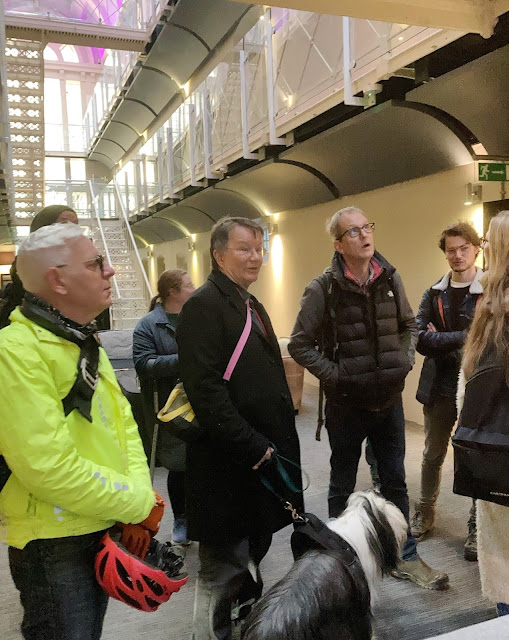
On 26 November, students taking the Oxford Brookes MSc in Historic Conservation went on walkabout in the city centre with Oxford heritage consultant Nicholas Worlledge (and his delightful dog, Button). Our first visit was to Frewin Hall, an important medieval house that once belonged to the lost college of St Mary. It has been owned since the Reformation by Brasenose College and is currently being converted into student accommodation, including a ‘deep retrofit’ to improve its energy efficiency.

Frewin Hall - the ground floor parlour contains a fine Elizabethan plaster ceiling and oak panelling

Frewin Hall - the undercroft below is far older, belonging to a Norman house of c.1100


Discussing urban design and traffic management strategies on Broad Street


Market Street, where a re-modelling of Oxford’s historic but commercially struggling Covered Market (est. 1774) is proposed in order to enhance public visibility, improve accessibility and – it is hoped – revive trade.


New Street, where the post-war County Council offices are shortly expected to become redundant, providing the largest city-centre development opportunity since the rebuilding of the Westgate Centre (seen in the background) in the 2010s

And finally, in the 19th-century ‘A’ wing of what was once Oxford Prison, and has since 2006 been the Malmaison Hotel. As Button demonstrates, well-behaved dogs are welcome.


Thanks to David Garrard for the report and photos. For more information on the MSc Historic Conservation, take a look at previous blog posts and our website.

And...follow us on Instagram @brookes_hcon

Tuesday, 26 November 2024

Urban Design 2024: first year competition

Laura Novo de Azevedo recently organised an 'in module' competition for the first year module 'Cities in Historic Contexts'. The brief was: create and Illustrate your idea of a good place which reflects the learning in the module. You will use any means that you'd like to explore such as AI, collage, photography, physical model, sketchup or video to visually show what a good place looks like from your professional perspective. Describe the qualities of this place in max 100 words (or use voice recording if creating a video). 

And the results: it was a very interesting exercise where students could quickly explore concepts around placemaking with the use of creative methods. AI seemed very powerful in providing quick sketchy responses whilst the use of video added a personal dimension that we didn't see in the AI submissions. it was very good to have a selection of different media. Congratulations to everyone that took part and especially to the following...


Overall winner: Eliza Allen 

2nd place: James Rumble

3rd Place: Gabriel Sankersingh


And...honourable mention for creativity: Lucas Pimentel

See all the entries on Padlet.

Click here for more information about the BA Urban Design, Planning and Development at Oxford Brookes. 


Wednesday, 5 June 2024

Urban Design End of Year Show 2024: CO-DWELLING WITH NATURE


For 2024, the theme of the Urban Design End of Year Show is: CO-DWELLING WITH NATURE. 

Students from MA Urban Design, the MArchD Urban Design and the BA Urban Design, Planning and Development have explored the idea of co-dwelling with nature in the built environment. The show is open until 5 July from 10am to 4pm each day and is located on the second floor of the Abercrombie Building on our Headington campus. Come and take a look!

Click here for further details.

I went along a few days after it opened to take some photos...


Don't forget to visit! The show is open until Friday 5 July from 10am to 4pm each day and is located on the second floor of the Abercrombie Building on our Headington campus. 


Wednesday, 24 April 2024

Institute of Historic Building Conservation: Student Awards 2023


Geometrical Elevation of Westminster Abbey (Middleton) and Tom Goodwin

IHBC Gus Astley Student Awards 2023...

CONGRATULATIONS to Thomas Goodwin (MSc Historic Conservation at Oxford Brookes University) who has taken the top award with a prize of £500 for his dissertation ‘Using ye Founder Kindly: Restoring, razing, and rebuilding historic buildings in early modern England (1660-1740).’

Thomas said: ‘I am delighted to have been awarded the Gus Astley Student Award for 2023 and look forward to attending the IHBC Annual School in Reading later this year. I would like to extend my gratitude to the IHBC, the Gus Astley Memorial Fund, now part of IHBC’s CREATIVE Conservation Fund, and the guest judge John Fidler. I am also thankful for the support and knowledge of the staff on the MSc in Historic Conservation at Oxford Brookes and the University of Oxford. The insight and constant encouragement of my supervisor, David Lewis, was particularly valuable.’

‘My project examined the history of conservation from 1660 to 1740, connecting emerging conservationist sensibilities in British architectural culture to changes in the theory and practice of architecture. It is surprising just how many enduring values and approaches pioneered in this period there have been. In the course of my research, I encountered everything from statements about the desirability of consciously adopting a contextual approach to design in historic settings, to a concerted campaign to preserve the best architecture of the recent past, in this case, the works of Inigo Jones.’

For more information on the MSc Historic Conservation click here:

MSc Historic Conservation


Friday, 27 October 2023

Urban Design@OBU 50th Anniversary Self Guided Walking Tour of Oxford

Looking southwest over Frideswide Square by Chaz2041 via WIKIMEDIA COMMONS

While you're in town for the 50th Anniversary celebrations, take a look at what's happened in the town since you were here.  We've put together a self-guided walking (cycling) tour past a range of new buildings and spaces in Oxford including: Frideswide Square, the Observatory Quarter, Broad Street, Weston Library, the Castle Quarter, Westgate and more.  In all likelihood, the route will also take you past some of your old haunts so it's also an opportunity to meet with old colleagues and catch up.  Some members of current staff will be doing the circuit in the afternoon of the 4th, starting about 13:00 at Frideswide Square. Link to 50th Anniversary Self Guided Walking Tour of Oxford - take a trip back and see what's new...